Financing Situation of Cultural and Tourism Groups in the First Quarter
According to incomplete statistics, in Q1 2025, there were 69 financing projects by cultural tourism groups (referring only to those issued and approved), with the number of projects slightly decreasing by -5.48% year-on-year compared to Q1 2024, involving 42 cultural tourism groups. The total financing amount was 47.641 billion yuan, a year-on-year decrease of about 10% (Q1 2024 was 52.853 billion yuan).
2. Financing Tools
In Q1, the debt financing tools for cultural tourism groups were mainly medium-term notes and ultra-short-term financing bonds, supplemented by short-term financing bonds and private placements. Medium-term notes have a relatively moderate issuance period, large financing scale, and relatively stable costs, making them suitable for cultural tourism groups for medium-term funding needs such as large-scale project construction and business expansion. Ultra-short-term financing bonds have a shorter issuance period, can raise funds quickly, and can meet the short-term capital turnover needs of cultural tourism groups.
2. Financing Performance of Cultural Tourism Groups in Some Provinces and Regions
According to statistical analysis, cultural tourism groups that successfully issued and completed financing in Q1 are distributed across 21 provinces (municipalities, autonomous regions, special administrative regions). Among them, cultural tourism groups in Jiangsu Province ranked first in both the number of bond issuance projects (16) and financing amount (6.039 billion yuan). Meanwhile, in addition to Jiangsu, cultural tourism groups in three other provincial-level administrative regions—Zhejiang, Beijing, and Hong Kong—all had financing amounts of 6 billion yuan or more, highlighting the relatively strong financial strength and prominent financing advantages of cultural tourism groups in economically developed regions. For example, the aforementioned provinces and regions boast leading cultural tourism groups such as Nanjing Tourism, Nanjing Business Tourism, Hangzhou Business Tourism, Zhejiang Tourism Investment, Shou Tourism Group, and China Tourism Group. These groups are relatively mature and leading in cultural tourism finance and capital operation, and have high credit ratings.

3. Financing Performance of Representative Cultural Tourism Groups
According to incomplete statistics, in Q1 2025, a total of 42 cultural tourism groups initiated and completed financing matters. Among them, Shou Tourism Group and China Tourism Group, two large state-owned enterprises, had the highest financing amounts, both at 6 billion yuan. Hangzhou Business Tourism Group and Gansu Public Aviation Tourism Group ranked in the second tier, both at 3 billion yuan. In terms of the number of financing projects, Guangxi Tourism Development Group led with a total of 5 completed transactions, including 3 short-term financing bond projects and 2 medium-term note projects. Yuyuan Inc. and Shou Tourism Group followed, each completing 4 transactions, showing active financing performance. Huaian Cultural Tourism Group, Kunshan Cultural Business Tourism Group, Hubei Three Gorges Cultural Tourism Group, and Fuzhou Gucuo Group closely followed, each issuing and completing 3 transactions, indicating gradually strengthened financing capabilities and enhanced market credibility.
China Tourism Group: It brings together numerous well-known tourism brands such as HKCTS, CTS, CITS, and China Duty Free, with businesses covering travel agencies, scenic spots, hotels, duty-free shops, cruises, and other fields. In Q1, CTS Resorts signed the plateau Gobi dual-brand resort hotel project and the Shandong Gaomi Metropark International Hotel project; CTS Duty Free signed an overseas strategic cooperation agreement with Tong Ren Tang Group to promote 'national trend going global'; CTS Asset Management completed the maiden voyage of the 'Starlight·Lancang-Mekong' silver-haired tourism themed train, etc. ... Overall, the investment and development trend is positive and stable, successfully issuing one short-term financing bond and one medium-term note, each with a single amount of 3 billion yuan, setting a new high for all groups.
Guangxi Tourism Development Group: The group covers six major business sectors: 'culture and tourism, health and wellness, urban construction, technology, finance, and industrial enterprises'. It is a large state-owned enterprise in Guangxi's tourism industry with the most complete tourism formats, the longest industrial chain, and the strongest capital strength. As of December 2024, the group's total assets amounted to 57.646 billion yuan. In Q1, a total of 5 bonds were successfully issued, with a total financing amount of 2.5 billion yuan.
Yuyuan Inc.: In recent years, Yuyuan Inc. has actively promoted its strategy of 'slimming down and strengthening, consolidating fundamentals', with initial results evident and recognition from financial institutions. In Q1, it successfully issued four tranches of ultra-short-term financing bonds, totaling 1.5 billion yuan. The company's main credit rating is AAA, with a stable outlook.
Hubei Three Gorges Cultural Tourism Group: The group owns 12 core cultural tourism enterprises, including the listed company Three Gorges Tourism and Yichang Taohualing Hotel, gradually forming a new pattern of physical industry development: '1 (listed company cruise industry development system) + 2 (hotel and scenic spot industries) + N (travel services, cultural media, automobile sales, business leisure, and other formats)'. In Q1, the group, based on its marketing strategy of 'deep cultivation domestically, radiating internationally', successively conducted promotional activities in Shijiazhuang, Tianjin, Jinan, Berlin (Germany), Madrid (Spain), and other places, promoting exchanges and cooperation in market expansion, route design, and reciprocal guest sources. In terms of financing, it successfully issued 3 bonds: 2 medium-term notes and 1 ultra-short-term financing bond, with a financing amount of 1.8 billion yuan.
In addition to the aforementioned groups, several other cultural tourism groups, represented by Hainan Tourism Investment, Guangdong Travel Control, Kaili Cultural Tourism Investment, and Enshi Tourism Group, are accelerating their financing progress. For example, in January, Hainan Tourism Investment Group successfully issued its first medium-term note, marking an important step for the company in the capital market. The issuance amount was 600 million yuan, with a coupon rate of 2.18%, setting a historic low for medium-term note coupon rates issued by enterprises in Hainan Province. This successful issuance fully demonstrates the capital market's high recognition of Hainan Tourism Investment and provides solid financial guarantees for the company's strategic layout and project advancement. In March, Enshi Tourism Group passed a 780 million yuan private bond on the Shanghai Stock Exchange. In 2025, the group will promote its 'Hundred Cities, Thousand Merchants, Ten Thousand Stores' channel strategy to support the high-speed growth and high-quality development of its cultural tourism sector.


 Summary and Trend Outlook
In Q1 2025, against the backdrop of policy dividends and consumption upgrades, the cultural tourism industry demonstrated strong market resilience. The investment side promotes industrial upgrading through structural innovation, while the financing side optimizes tools to improve the efficiency of secured fund allocation, jointly supporting the industry's evolution towards 'high quality and refinement'. In the future, leading enterprises with resource integration capabilities, industry innovation advantages, and capital operation experience are expected to further expand their leading edge amidst industry differentiation, while regional cultural tourism groups need to accelerate the construction of differentiated positioning and operational capabilities to cope with market competition and sustainable development needs.
Looking ahead to Q2, cultural tourism groups' investment and financing are expected to see a steady increase in overall activity, driven by holiday consumption boosts (Qingming, May Day, Dragon Boat Festival), deepening policy dividends, improving market expectations, return of high-end cultural tourism consumption, and rising inbound tourism. However, risks such as the escalating US-China tariff disputes and increased global economic uncertainty also exist. Domestic cultural tourism groups' investments will focus on the domestic demand market, while overseas investments will tend towards investment-friendly countries and emerging markets like Southeast Asia, countries along the 'Belt and Road' initiative, and Saudi Arabia and the UAE in the Middle East. This also compels domestic cultural tourism enterprises to accelerate independent R&D and innovation processes in the industrial chain and promote the upgrading of local cultural tourism industrial chain equipment manufacturers. As for international cultural tourism hotel groups' investment in China, US-China tariff policies will short-term raise their investment costs in China and trigger certain strategic retrenchments.
Recommended Important Cultural and Tourism Events
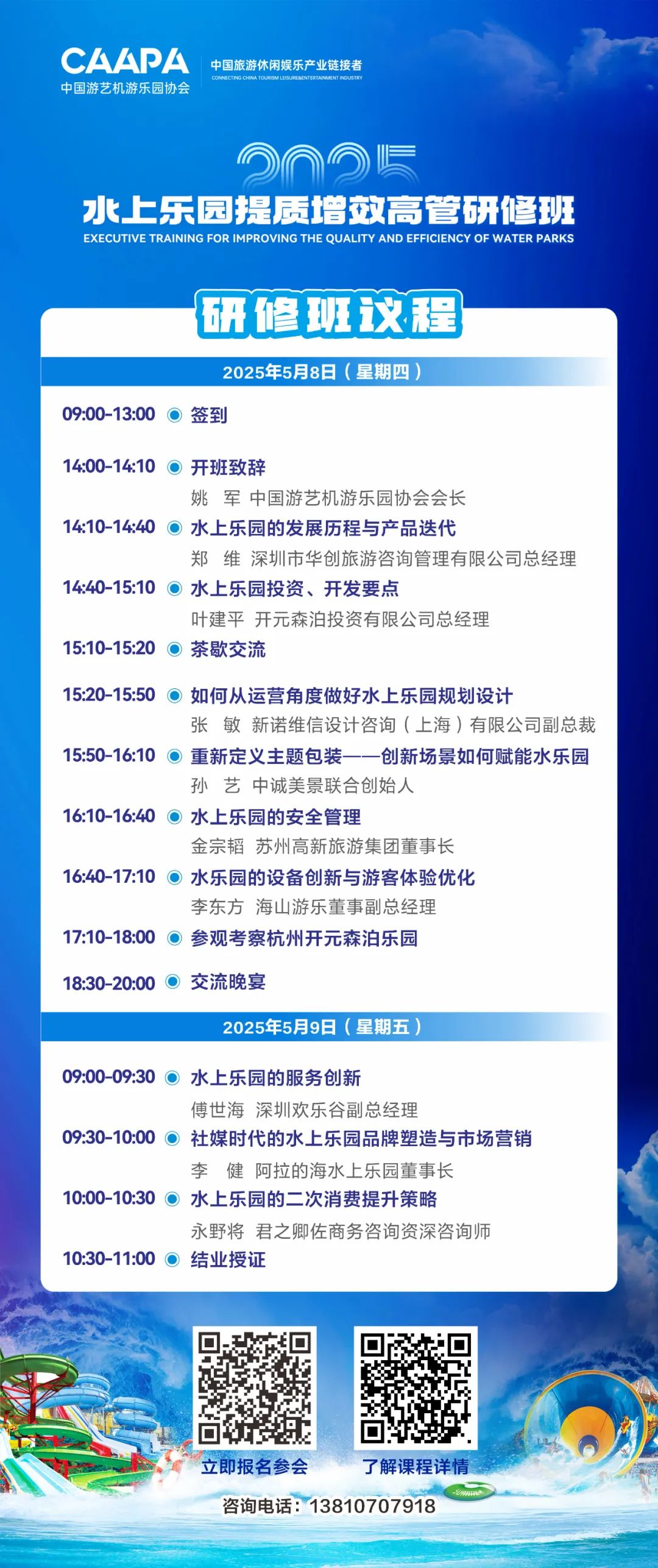
2025 Water Park Quality Improvement and Efficiency Enhancement Senior Executive Training Class
May 8-9, Hangzhou Kaiyuan Senbo Water Park